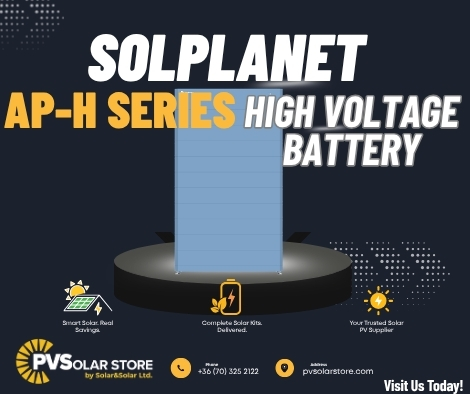
Built around modular LiFePO4 battery technology, the AP-H starts at 10.24 kWh and can be expanded to 51.2 kWh in a single tower. For projects requiring substantially more storage, Solplanet allows up to four towers to operate in parallel, increasing the total nominal energy capacity to 204.8 kWh.
That wide capacity range makes the AP-H particularly interesting for solar installers and EPC companies looking for one battery platform that can cover everything from a larger residential napelemes rendszer to demanding commercial energy storage applications.
One Battery Platform, Nine Capacity Configurations
The AP-H is built around the APH 5.0 battery module, with each module contributing approximately 5.12 kWh of nominal storage capacity. A complete battery tower requires at least two modules, giving the smallest APH5.0-S2 configuration a nominal capacity of 10.24 kWh and 9.72 kWh of usable energy.
From there, the system can grow module by module. Three modules provide 15.36 kWh, four provide 20.48 kWh, and the largest ten-module APH5.0-S10 reaches 51.2 kWh nominal and 48.64 kWh usable energy.
This is one of the practical strengths of the system. Installers do not need to move to a completely different battery family when a project requires more capacity. The same architecture covers a broad range of applications.
Solplanet specifies 95% depth of discharge, which means that almost the entire installed battery capacity can be used during normal operation under the manufacturer’s defined conditions. Round-trip efficiency is rated at 95% or higher.
Up to 204.8 kWh with Four Parallel Towers
A single AP-H tower can reach 51.2 kWh, but the platform does not stop there.
Solplanet states that up to four towers can be connected in parallel, increasing the maximum nominal system capacity to 204.8 kWh.
This opens the AP-H to applications that go well beyond a conventional small residential solar battery.
A large home with significant evening consumption, an EV charger or a heat pump may require considerably more storage than a typical 10 kWh system. Larger commercial properties may need tens or even hundreds of kilowatt-hours to increase solar self-consumption, reduce grid imports or provide greater energy flexibility.
The important point for installers is that maximum battery scalability must always be checked against the connected solar inverter. A battery platform may support four towers, while a particular inverter or project configuration may impose a lower system limit.
High-Voltage Architecture with Power That Grows with Capacity
The AP-H is a true high-voltage battery system. As modules are added, both battery voltage and available charge/discharge power increase.
The smallest 10.24 kWh configuration operates at a nominal voltage of 102.4 V and provides 5.12 kW of rated charge and discharge power. At the top of the range, the 51.2 kWh APH5.0-S10 reaches 512 V nominal voltage and 25.6 kW of rated charge/discharge power.
Recommended and maximum charge/discharge current are both specified at 50 A across the platform.
For system designers, this means capacity cannot be considered independently from inverter voltage range and battery input capability. The exact AP-H configuration should be selected together with the compatible Solplanet hybrid inverter rather than treating the battery as a standalone component.
Confirmed Compatibility with Solplanet Hybrid Inverters
Solplanet’s Hybrid Battery Compatibility List, Version 1.9 from July 2026, confirms the AP-H Series for several current high-voltage hybrid inverter platforms.
The AP-H appears as an approved battery option for the ASW05/06/08/10/12kH-T2, ASW08/10/12kH-T3, corresponding T2-DG and T3-DG models, as well as the larger ASW015/020/025/030K-TH Series.
This is particularly important for professional procurement. Battery compatibility should never be assumed simply because the inverter and battery carry the same brand.
The inverter’s supported voltage range, firmware, BMS protocol and permitted battery configuration all have to match. Solplanet’s compatibility documentation provides installers with a much clearer basis for designing complete systems.
For projects using models outside the published list, Solplanet specifically recommends confirming compatibility with AISWEI before installation.
LiFePO4 Chemistry and Integrated Fire Suppression
Battery safety is clearly one of the major design priorities of the AP-H platform.
Solplanet uses LiFePO4 cells together with an intelligent battery management system. The battery enclosure also includes a built-in emergency fire suppression module, providing an additional layer of protection inside the system.
The datasheet lists IEC 62619, IEC 62040, IEC 63056 and IEC 61000 certifications and specifies a cycle life of 6,000 cycles under defined test conditions.
As with any energy storage system, this does not remove the need for correct system design. Installation position, electrical protection, clearances, operating temperature and local fire requirements must still be considered by the installer.
IP65 for Indoor and Outdoor Installation
The AP-H carries an IP65 protection rating and is specified for both indoor and outdoor use.
The operating temperature range is 0°C to 58°C while charging and -20°C to 58°C while discharging. Natural convection cooling means the battery does not rely on a conventional fan-based cooling system.
The maximum operating altitude is 4,000 metres, with derating above 3,000 metres.
These specifications provide considerable installation flexibility, although the actual site should always be assessed for direct sunlight, flooding, service access and environmental exposure.
Compact Design Despite the Large Capacity
Large energy storage systems can quickly become difficult to accommodate in technical rooms and garages. Solplanet has deliberately kept the AP-H relatively compact.
Even the full 51.2 kWh tower is only 1.8 metres high, with a footprint of approximately 1040 × 250 mm.
The narrow 250 mm depth is particularly useful where wall clearance is limited. Solplanet specifically highlights garages and walkways as potential installation environments.
The system is floor mounted, and its weight increases from 111 kg for the 10.24 kWh configuration to 479 kg for the complete 51.2 kWh tower. Structural capacity and handling requirements should therefore be planned before installation.
Plug-and-Play Architecture for Faster Installation
For a napelemes telepítő, installation time directly affects project cost.
Solplanet describes the AP-H as a plug-and-play battery system, with stackable modules designed to simplify assembly and commissioning. Communication with the inverter is handled through CAN.
This modular design is especially useful for installers working across multiple project sizes. The same basic battery architecture can be configured differently without requiring a completely different installation concept each time.
The Solplanet app also allows the battery’s LED operating indicator to be configured from five available selections, adding a small but practical element of user customisation.
Solplanet AP-H Technical Overview
| Specification |
AP-H Series |
| Battery chemistry |
LiFePO4 |
| Capacity per battery module |
Approx. 5.12 kWh |
| Minimum tower capacity |
10.24 kWh |
| Maximum tower capacity |
51.2 kWh |
| Maximum parallel towers |
4 |
| Maximum system capacity |
204.8 kWh |
| Usable energy per tower |
9.72–48.64 kWh |
| Depth of discharge |
95% |
| Round-trip efficiency |
≥95% |
| Maximum charge/discharge current |
50 A |
| Maximum tower power |
25.6 kW |
| Communication |
CAN |
| Protection rating |
IP65 |
| Installation |
Indoor / Outdoor |
| Mounting |
Floor mounted |
| Cycle life |
6,000 cycles |
| Maximum operating altitude |
4,000 m |
| Largest tower height |
1.8 m |
These specifications are based on Solplanet's AP-H technical datasheet.
Why AP-H Is Interesting for Installers and EPC Companies
The biggest advantage of the AP-H is not one headline specification. It is the flexibility created by combining a wide capacity range with confirmed compatibility across several Solplanet hybrid inverter families.
A residential project can use 10.24 or 15.36 kWh. A larger home may require 20 to 30 kWh. A commercial application can use a full 51.2 kWh tower or potentially multiple towers where supported by the inverter and overall system design.
That makes purchasing and system standardisation easier for installers who want to work with fewer battery platforms across different customer types.
The combination of LiFePO4 cells, IP65 protection, integrated fire suppression and 95% usable depth of discharge also places the AP-H firmly within the new generation of modular high-voltage energy storage products.
For a solar distributor or solar wholesaler, this kind of scalability can also simplify stock planning because a relatively small number of modular components can cover many different complete-system configurations.
What to Check Before Ordering
Before specifying an AP-H battery, the installer should confirm the exact Solplanet inverter model, required battery capacity and number of towers.
The July 2026 compatibility list should be used as the primary reference for current inverter compatibility, especially because Solplanet notes that the document is updated periodically.
It is also worth checking the complete system rather than only the battery modules. A procurement-ready energy storage package may require the battery modules, control equipment, compatible solar inverter, communication accessories and all required electrical protection.
For B2B procurement, warehouse stock should therefore be confirmed for the complete configuration rather than simply checking whether AP-H modules are available.
The Solplanet AP-H Series is a strong example of how residential and commercial energy storage is evolving: higher capacity, more scalable architecture and closer integration between the solar inverter and battery system. For professional installers, its real value lies in being able to design anything from a 10.24 kWh residential battery to a system exceeding 200 kWh around one modular platform.
FAQ SEO
What capacity does the Solplanet AP-H battery provide?
A single AP-H tower can provide between 10.24 kWh and 51.2 kWh of nominal storage, depending on whether two to ten APH 5.0 modules are installed.
What is the maximum capacity of a Solplanet AP-H system?
Up to four 51.2 kWh towers can be connected in parallel, giving a maximum nominal capacity of 204.8 kWh.
What battery chemistry does the Solplanet AP-H use?
The AP-H Series uses LiFePO4 battery cells together with an intelligent battery management system.
What is the depth of discharge?
Solplanet specifies a 95% depth of discharge, with the largest 51.2 kWh configuration providing 48.64 kWh of usable energy.
Is the Solplanet AP-H suitable for outdoor installation?
Yes. The AP-H is rated IP65 and specified for both indoor and outdoor installation.
Which Solplanet inverters are compatible with AP-H?
The July 2026 compatibility list confirms AP-H compatibility with the ASW05/06/08/10/12kH-T2, ASW08/10/12kH-T3, relevant DG variants and the ASW015/020/025/030K-TH Series.