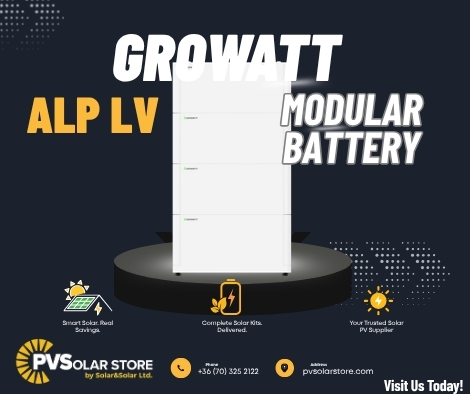
The Growatt ALP LV-US Modular Battery has been developed around exactly this idea. Instead of using one fixed battery capacity, the system is built from individual 5 kWh LiFePO4 modules that can be combined into progressively larger configurations. A single battery cluster can provide between 5 and 40 kWh of nominal storage capacity, while Growatt states that up to eight clusters can operate in parallel, increasing the maximum theoretical system capacity to 320 kWh.
That level of scalability gives installers much more freedom when designing a low-voltage energy storage system. A smaller installation can begin with one or two modules, while larger projects can use significantly more capacity without moving to an entirely different battery platform.
A Modular Battery That Can Grow with the Solar PV System
At the centre of the ALP LV-US platform is the Growatt ALP 5.0L-E2 US battery module. Each module provides 5 kWh of nominal energy capacity and 4.6 kWh of usable capacity. The battery operates at a nominal voltage of 51.2 V, with an operating range of 46.4 to 57.6 V. Growatt specifies a 92% depth of discharge and a DC-to-DC round-trip efficiency of 94%.
Adding additional modules increases the system capacity in 5 kWh steps. Two modules create a 10 kWh system, four modules provide 20 kWh, and eight modules form a 40 kWh battery cluster with 36.8 kWh of usable energy.
This approach makes system sizing easier for projects where future electricity demand is difficult to predict. A homeowner may initially need only 10 kWh of battery storage, but later add more solar panels, an electric vehicle, heat pump or other electrical loads. A modular energy storage platform provides more flexibility than a battery that is permanently limited to one capacity.
For professional solar installers, this can also simplify project planning. Instead of working with several completely different battery families, the same basic platform can be used across a wider range of system sizes.
From 5 kWh Residential Storage to Larger Energy Storage Systems
The most interesting feature of the Growatt ALP LV-US is its overall scalability.
Growatt allows up to eight ALP battery modules within a single cluster, producing a maximum capacity of 40 kWh. The manufacturer also states that up to eight clusters can be connected in parallel. In the largest permitted configuration, this gives a total nominal capacity of 320 kWh.
That does not mean that every project should use such a large system, or that every solar inverter can support the maximum configuration. Battery scalability and inverter compatibility must always be considered separately.
A 320 kWh battery system would require careful engineering around communication, cable sizing, current limits, protection, inverter capability and installation layout. The connected inverter must specifically support the chosen number of battery modules and parallel clusters.
This is therefore a useful platform for scalable storage, but the final system must still be designed as one complete electrical installation.
Higher Capacity Also Brings Higher Discharge Capability
As more battery modules are added, the available charge and discharge current increases.
A single 5 kWh ALP module supports 60 A of continuous charge and discharge current and a maximum continuous discharge power of 3 kW. With two modules, this rises to 120 A and 6 kW. A 15 kWh configuration reaches 180 A and 9 kW.
From the 20 kWh configuration onwards, Growatt specifies a maximum continuous current of 220 A and a maximum continuous discharge power of 11 kW. Larger 25, 30, 35 and 40 kWh battery configurations retain the same 220 A and 11 kW limits.
This is important when designing the complete solar PV system. Increasing battery capacity provides more stored energy, but after a certain point it does not continue increasing the maximum continuous discharge power.
For example, moving from 20 kWh to 40 kWh doubles the available stored energy, but the maximum continuous discharge rating remains 11 kW according to the Growatt datasheet. The additional capacity therefore increases how long the battery can support a given load rather than increasing the maximum output indefinitely.
Growatt also notes that charging and discharging current can be reduced depending on battery temperature and state of charge.
LiFePO4 Chemistry for Stationary Energy Storage
Growatt uses cobalt-free lithium iron phosphate, or LiFePO4, cells in the ALP LV-US platform.
LiFePO4 has become one of the most common battery chemistries for stationary energy storage because it offers a practical combination of thermal stability, cycle performance and usable energy capacity. For a residential or larger solar battery installation, however, cell chemistry is only one part of the overall safety concept.
The complete system also depends on the battery management system, electrical protection, correct cable sizing, inverter communication and appropriate installation conditions.
The Growatt battery management system monitors state of charge, system voltage, current, individual cell voltage, cell temperature and PCBA temperature. Communication with compatible equipment is provided through CAN.
For installers, this means that matching the battery voltage alone is not enough. The selected solar inverter must also support the required CAN communication and the exact ALP battery configuration.
A Low-Voltage 51.2 V Battery Architecture
The Growatt ALP LV-US is a low-voltage battery system with a nominal voltage of 51.2 V.
This makes it fundamentally different from high-voltage battery stacks that may operate at several hundred volts. Low-voltage storage remains popular in many residential and small commercial applications because of its familiar architecture and flexible modularity.
However, higher battery current is required to deliver substantial power at a lower voltage. This makes correct cable selection, protection devices and inverter compatibility particularly important.
The published operating voltage of the ALP LV-US is 46.4 to 57.6 V. Any connected inverter must be designed to work safely inside this range and support the required charge and discharge current.
Wall-Mounted or Floor-Standing Installation
Growatt has also designed the ALP LV-US with installation flexibility in mind.
The battery can be mounted on a wall or installed on the floor. Floor installation requires an additional base. Growatt recommends arranging systems containing more than five battery packs in two rows rather than building one excessively tall stack.
The physical weight becomes increasingly important as capacity grows. One 5 kWh module weighs 46 kg, while an eight-module 40 kWh configuration reaches approximately 368 kg before the additional floor base is included.
This is why mechanical planning should be part of the installation process from the beginning. A wall that is suitable for one module may not necessarily be appropriate for a larger configuration.
The same applies to floor installation. The installer should consider available space, service access, cable routing and the load-bearing capability of the installation surface.
IP66 Protection for Flexible Installation Environments
The ALP LV-US carries an IP66 / NEMA Type 4X protection rating. Growatt specifies an operating temperature range from -10°C to +50°C.
This gives installers more flexibility when choosing the installation location, although an IP rating should never be interpreted as permission to place the battery anywhere.
The system still needs to be protected from flooding, mechanical damage and unsuitable environmental exposure. Adequate service access also needs to remain available throughout the lifetime of the battery.
Temperature is particularly important because Growatt states that charge and discharge current may be derated depending on operating temperature and state of charge.
92% Depth of Discharge Means Capacity Should Be Compared Carefully
Battery capacity can be misleading when only nominal kWh is considered.
The Growatt ALP 5.0L-E2 US provides 5 kWh of nominal capacity, but 4.6 kWh of usable capacity. This corresponds with the manufacturer’s stated 92% depth of discharge.
The same relationship continues through larger configurations. A 20 kWh system provides 18.4 kWh of usable energy, while the 40 kWh configuration provides 36.8 kWh.
For installers and B2B buyers, usable capacity is normally the more relevant figure when estimating how long the battery can support household or commercial loads.
If a customer needs approximately 15 kWh of usable storage, selecting a battery purely from its 15 kWh nominal label would not provide the same usable energy.
What the 94% Efficiency Figure Really Means
Growatt specifies a 94% DC-DC round-trip efficiency for the ALP LV-US.
This figure relates to the battery-side conversion path. It should not be presented as the total efficiency of the complete solar energy storage system.
A finished installation also includes losses from the solar inverter or battery inverter, wiring and the conversion between AC and DC electricity.
The final AC-to-AC efficiency of a complete system can therefore be lower than the battery’s published DC-DC figure.
This distinction matters when comparing different energy storage solutions. Procurement teams should always compare efficiency figures measured under similar conditions.
Inverter Compatibility Remains One of the Most Important Checks
A modular solar battery can only perform correctly when it communicates properly with the inverter.
The ALP LV-US uses CAN communication. The inverter must therefore understand the battery management system and operate within Growatt’s specified voltage and current limits.
For professional installers, the correct procedure is to confirm the exact inverter model against the manufacturer’s current compatibility documentation before ordering the battery.
This becomes especially important in larger installations. A battery platform may technically support eight parallel clusters, but the inverter may support fewer.
The maximum system configuration is therefore determined by the complete system, not by the battery datasheet alone.
What Solar Installers and B2B Buyers Should Consider Before Ordering
The Growatt ALP LV-US is best treated as a configurable energy storage platform rather than one single product.
A professional quotation should clearly state the number of ALP 5.0L-E2 US modules, the total nominal and usable capacity, the compatible inverter and any additional bases or accessories required for the final installation.
Warehouse availability should also be checked for the exact configuration. A supplier may have individual 5 kWh battery modules in stock without having every accessory required for a complete 20 or 40 kWh installation.
For a solar wholesaler or B2B solar webshop, clear product configuration is particularly important. A customer comparing battery prices needs to know whether the advertised price covers one battery module or an operational complete energy storage system.
The same applies to future expansion. Installers should confirm whether additional modules can be added later, whether the connected inverter supports the larger configuration and whether Growatt imposes any requirements concerning battery age, configuration or commissioning.
Important Note for European Buyers
The uploaded Growatt document is specifically titled ALP LV-US Modular Battery and contains Growatt USA contact information.
The datasheet lists UL1973, UL9540A, FCC, UN38.3 and RoHS.
These documents should not automatically be treated as confirmation that the same battery version is approved for every European market.
A European solar distributor, solar wholesaler or installer should verify the exact regional product version and required compliance documentation before offering the ALP LV-US for sale or installing it in an EU project.
This is especially important for online product listings, where certification claims should always correspond with the exact battery that will actually be delivered.
A Flexible Battery Platform for Projects That May Grow
The strongest argument for the Growatt ALP LV-US is not one individual specification. It is the way the different characteristics work together.
A project can begin with a compact 5 or 10 kWh solar battery and scale into a significantly larger energy storage system using the same basic platform. The 51.2 V architecture, LiFePO4 chemistry, CAN communication, IP66 enclosure and up to 220 A continuous current provide a practical foundation for low-voltage battery systems.
For homeowners, that can mean more flexibility when future electricity demand increases. For professional solar installers and EPC companies, it can simplify system design across projects requiring different storage capacities.
The important part is to treat the ALP LV-US as part of a complete system. Correct inverter compatibility, usable battery capacity, physical installation, communication and regional compliance remain just as important as the headline 5–320 kWh scalability.
For a solar PV supplier or solar wholesaler, that is also where professional value is created: not simply by supplying a battery, but by ensuring that the right battery configuration, compatible solar inverter and required accessories reach the project together.